



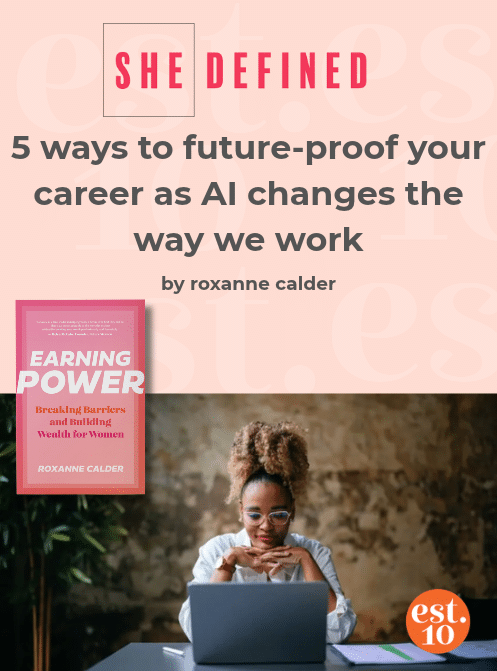
5 ways to future-proof your career as AI changes the way we work

Posted On 28 Oct 2026

5 ways to future-proof your career as AI changes the way we work

28 Oct 2026
5 ways to future-proof your career as AI changes the way we work

Candidate Resource, Employer Resource, Interview Tips, On The Job, Popular Culture

5 ways to future-proof your career as AI changes the way we work

Employees are now given a curious piece of career advice: learn to use the machine that may eventually replace you and your job. Impress your employer with how efficiently you can use it, and, if possible, avoid dwelling on where all this may ultimately lead. Under the circumstances, a little anxiety seems reasonable.

The real problem is that nobody can tell you with confidence what your job will look like in five years. You cannot future-proof a job against a technology that is still developing.

Some tasks will disappear. Entirely new roles will emerge. Jobs that appear vulnerable today may prove surprisingly durable, while occupations currently thought to be safe may change much faster than expected.

So, how do you future-proof your career when you have no idea what your job will look like in five years? Here are five ways:

1. Use AI. Then master its blind spots

Employees are increasingly expected to understand the tools available to them, just as earlier generations were expected to become comfortable with email, search engines, spreadsheets and new software.

But understanding AI should mean more than prompts and chats. Use AI on real work. See what it does brilliantly. Notice where it becomes generic, overly confident or strangely literal. Give it a task you know extremely well and examine what it misses.

There is a profound difference between someone who can operate AI and someone who understands how to supervise it. The second person knows when the answer is impressive and when something important has been left out.

As we move towards the future, employers will increasingly value people who can identify errors in AI judgement.


2. Don’t outsource your apprenticeship

This may be one of the less obvious career risks of the AI era. Routine work can be tedious. It’s also often how expertise is built.

Junior lawyers sift through documents, meticulously analysing every line. Graduate accountants reconcile figures. Entry-level marketers write imperfect copy. New managers stumble through difficult conversations. People learn by doing the work they will one day become experienced enough to do differently.

If you let AI bypass that apprenticeship entirely, you risk sacrificing the experience that makes you valuable for tomorrow.


3. Move closer to judgement

With AI producing answers quicker than we ever could, the advantage belongs to the employee who decides which answer deserves attention. That’s judgement.

Knowing what matters, recognising quality, spotting risk and understanding consequences – this is harder than it sounds because judgement is rarely learned from a course. It develops through exposure. See how business scenarios play out in real life.

Seek out senior colleagues’ advice, understand the process behind decisions or why an idea was rejected when it seemed like an obvious option. And build expertise in something. Deep knowledge gives you a reference point, allowing you to apply judgement to an AI-generated answer.

4. Build the parts of your career that live in other people’s heads

Much of the discussion about AI concentrates on skills. Careers have never operated on skills alone. Relationships, reputation and the confidence others have in you matter just as much.

Be known for something that no software can replicate. That’s our deeply human skill of how we make people feel. Be the person who can calm a tense room, is trusted with sensitive information, gives sensible advice under pressure or can disagree without turning it into a small civil war.

A reputation for being thoughtful, reliable and someone people want to work with continues to create opportunity.

5. Stop trying to predict 2031

There is a small absurdity in being told to prepare today for a labour market that experts themselves cannot describe with confidence. You don’t need to identify the perfect future occupation. You need to stay close enough to change that you notice when your value is moving.

Try the new software before it becomes compulsory. Volunteer for a project slightly outside your normal remit. Spend time with people doing work adjacent to yours. Every few months, ask which parts of your role have become easier and what has become more valuable.

Future-proofing your career isn’t a complete reinvention of yourself. Successful careers rarely kick off with a trumpet blast. They begin changing in less flattering ways. It can be that the task people used to bring you now goes to a system. The four-hour job now taking 10 minutes, or clients asking for something a bit different. And the skill that once made you valuable becomes something everybody seems to have. Notice those changes early enough, and you can move with them.

The people most likely to navigate the next five years may not be those who correctly predict what AI will be capable of. They will be the ones who keep finding out what AI can do, what they can still do better, and who have the good sense not to assume either answer will remain true for very long.

Your job may be almost unrecognisable in five years. There’s no reason you must be.

About the author
Roxanne Calder
Managing Director

As Founder and Managing Director at EST10, Roxanne has an all-encompassing role that includes building and growing the business, as well as actively recruiting and consulting.

After completing a Bachelor’s Degree at Monash University, Roxanne began her recruitment career with renowned recruiter Julia Ross. From there, Roxanne worked in HR and recruitment with a number of global players and boutique businesses throughout Australia, the UK, Singapore and Hong Kong for over 20 years. She has been responsible for managing large teams and projects, implementing RPO models, managing and assisting businesses to an IPO and assisting companies in setting up their recruitment teams and processes.

Following completion of her MBA at the Australian Graduate School of Management, Roxanne launched EST10 in July 2010. In doing so, she hoped to combine the flexibility and high touch service levels of boutique agencies with the structure and strategy afforded to larger firms. Roxanne believes in high-touch, high-care consulting and is always on the lookout for consultants that share this vision of recruitment.

Our Blog
Related Articles
How self-sabotaging is your career’s number 1 enemy
Most of us are aware of the concept of self-sabotage. We have read about it, perhaps even pondered i...
Invisible Ink
Have you heard of ‘invisible ink’ before? If I have worked on a job brief with you, I would have...
He’s just not that into you!
Fly undone? Excruciating to hear but necessary to know. One, single dark facial hair on your chin (i...
Invisible Ink
Have you heard of ‘invisible ink’ before? If I have worked on a job brief with you, I would have...
He’s just not that into you!
Fly undone? Excruciating to hear but necessary to know. One, single dark facial hair on your chin (i...
How self-sabotaging is your career’s number 1 enemy
Most of us are aware of the concept of self-sabotage. We have read about it, perhaps even pondered i...
He’s just not that into you!
Fly undone? Excruciating to hear but necessary to know. One, single dark facial hair on your chin (i...
How self-sabotaging is your career’s number 1 enemy
Most of us are aware of the concept of self-sabotage. We have read about it, perhaps even pondered i...
Invisible Ink
Have you heard of ‘invisible ink’ before? If I have worked on a job brief with you, I would have...
Important Notice: Fraudulent Recruitment Messages