



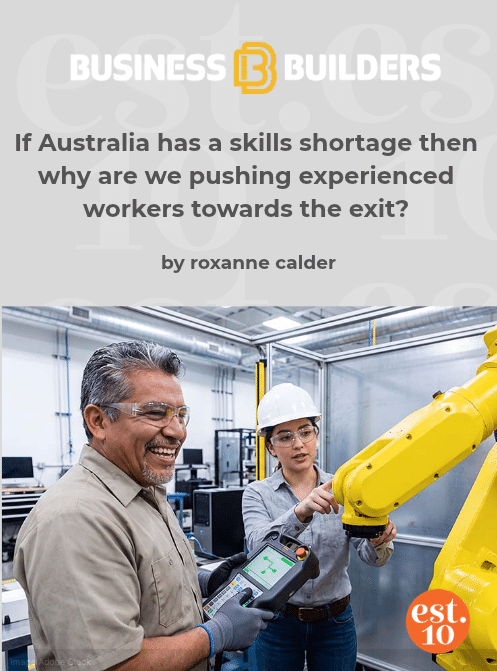

If Australia has a skills shortage then why are we pushing experienced workers towards the exit?

Posted On 7 Oct 2026

If Australia has a skills shortage then why are we pushing experienced workers towards the exit?

7 Oct 2026
If Australia has a skills shortage then why are we pushing experienced workers towards the exit?

Candidate Resource, Employer Resource, Interview Tips, On The Job, Popular Culture

If Australia has a skills shortage then why are we pushing experienced workers towards the exit?

Are you tired of reading ad nauseam about Australia’s skills and talent shortage? Me too. But for a different reason, I’m sure. Yours is likely due to boredom and a yawn of ‘that old adage.’ Mine, well its frustration, knowing that while headline numbers have eased, critical skills shortages remain unresolved.  

As the managing director of a recruitment firm, I have a front-row seat to the exasperating problem. The consequences go beyond unfilled vacancies. The skills constraint intensifies competition for talent, pushes salaries higher, and fundamentally shifts the balance of power between employers and employees.

Currently, our workforce has higher rates of workplace stress and 54.3 per cent of the global workforce sits in the ‘challenged’ resilience category- functioning day to day, but fragile under pressure. Succession pipelines are tight, and the concern for changing attitudes towards work dominates leadership and human resource (HR) conversations.  Persistent skills shortages are adding further pressure to an already stretched workforce. And there’s worse to come. We are about to lose our most valuable workers, and no one is talking about it.   The workers I refer to are 51 years and above. You might, however, call them ‘older workers.’ They are hardly a marginal group. Australians aged 55 and over alone account for nearly one in five employed people. That is a sizeable part of the workforce to misunderstand, undervalue or to eventually lose.

The label

Nearly a quarter of Australian HR professionals surveyed now classify workers aged 51–55 as ‘older’, more than double the proportion recorded in 2023 (10 per cent). Of course, no one is talking about losing these employees when the label itself, ‘older’, immediately conjures decline rather than value. We readily celebrate age when it improves wine, whiskey and vintage cars. Yet when it comes to people, we assume the opposite. Experience is valuable and a competitive advantage.

Knowledge management

Knowledge management is critical for modern organisations. One of the most valuable knowledge assets and institutional memory holders are experienced workers. Yet the contradiction is difficult to miss. According to a survey conducted by the Australian HR Institute (AHRI), 59 per cent say the departure of older workers has led to the loss of important skills or knowledge in their organisation. However, only 13 per cent say that knowledge is consistently captured. Perhaps that is because much of what experienced employees know cannot be deposited into a handover document during their final fortnight. Organisational memory includes judgement: which risk is real, which client objection matters, which apparent shortcut will create six months of chaos. It lives in decisions, relationships and pattern recognition accumulated over time.


Put to pasture

There is that peculiar point in a career when a capable employee slowly disappears from the organisation’s idea of its future. We complain that ‘older’ workers lack contemporary skills when excluding them from the opportunities to acquire them. The invitation to the leadership program no longer arrives. The stretch assignment goes elsewhere. Training money follows those with ‘potential’, as though potential has an expiry date. Interestingly, we still ask they calm the difficult client, explain why a system was designed a certain way, and recognise problems others have not seen before. At 52, an employee may still have well over a decade before retirement. Sadly, though, their employer has already started the retirement process.

Taught how to think

We condition our workforce to cognitively offload. On a base level, the days of recalling shopping lists and phone numbers from memory alone are gone. The reliance on AI and tech shortcuts raises a genuine concern for muscle atrophy. Ok, the brain is not a muscle, but I’m trying to be polite. The advantage of the mature worker is that they have gone from analogue to digital, from hands-on to hands-free. Why does this matter? Because they understand the thinking and the how. This is vital when things go wrong.

How soon is soon?

It’s soon. For workforce succession planning, the numbers are significant. More than 800,000 Australians aged 45 and over intend to retire within the next five years. The demographic pressure is real, but the more important issue is not simply how many people leave. It is what leaves with them. The harder problem is that capability does not transfer neatly by headcount. A new employee can fill a position. They cannot immediately replace twenty or thirty years of judgment, relationships, technical memory and pattern recognition. Those things are accumulated slowly and often become visible only when something goes wrong. This is not an argument against Millennials, Gen Z or the generations following them. They will build expertise of their own. The workforce challenge is the period in between: whether organisations transfer enough knowledge and capability before experienced workers decide to leave.

No organisation, of course, should preserve every employee indefinitely. Businesses change, roles become obsolete, and some people should leave. Older workers are also not corporate archives whose accumulated knowledge belongs to the business forever. The issue is an avoidable form of loss and we need to start talking about it.

About the author
Roxanne Calder
Managing Director

As Founder and Managing Director at EST10, Roxanne has an all-encompassing role that includes building and growing the business, as well as actively recruiting and consulting.

After completing a Bachelor’s Degree at Monash University, Roxanne began her recruitment career with renowned recruiter Julia Ross. From there, Roxanne worked in HR and recruitment with a number of global players and boutique businesses throughout Australia, the UK, Singapore and Hong Kong for over 20 years. She has been responsible for managing large teams and projects, implementing RPO models, managing and assisting businesses to an IPO and assisting companies in setting up their recruitment teams and processes.

Following completion of her MBA at the Australian Graduate School of Management, Roxanne launched EST10 in July 2010. In doing so, she hoped to combine the flexibility and high touch service levels of boutique agencies with the structure and strategy afforded to larger firms. Roxanne believes in high-touch, high-care consulting and is always on the lookout for consultants that share this vision of recruitment.

Our Blog
Related Articles
How self-sabotaging is your career’s number 1 enemy
Most of us are aware of the concept of self-sabotage. We have read about it, perhaps even pondered i...
Invisible Ink
Have you heard of ‘invisible ink’ before? If I have worked on a job brief with you, I would have...
He’s just not that into you!
Fly undone? Excruciating to hear but necessary to know. One, single dark facial hair on your chin (i...
Invisible Ink
Have you heard of ‘invisible ink’ before? If I have worked on a job brief with you, I would have...
He’s just not that into you!
Fly undone? Excruciating to hear but necessary to know. One, single dark facial hair on your chin (i...
How self-sabotaging is your career’s number 1 enemy
Most of us are aware of the concept of self-sabotage. We have read about it, perhaps even pondered i...
He’s just not that into you!
Fly undone? Excruciating to hear but necessary to know. One, single dark facial hair on your chin (i...
How self-sabotaging is your career’s number 1 enemy
Most of us are aware of the concept of self-sabotage. We have read about it, perhaps even pondered i...
Invisible Ink
Have you heard of ‘invisible ink’ before? If I have worked on a job brief with you, I would have...
Important Notice: Fraudulent Recruitment Messages